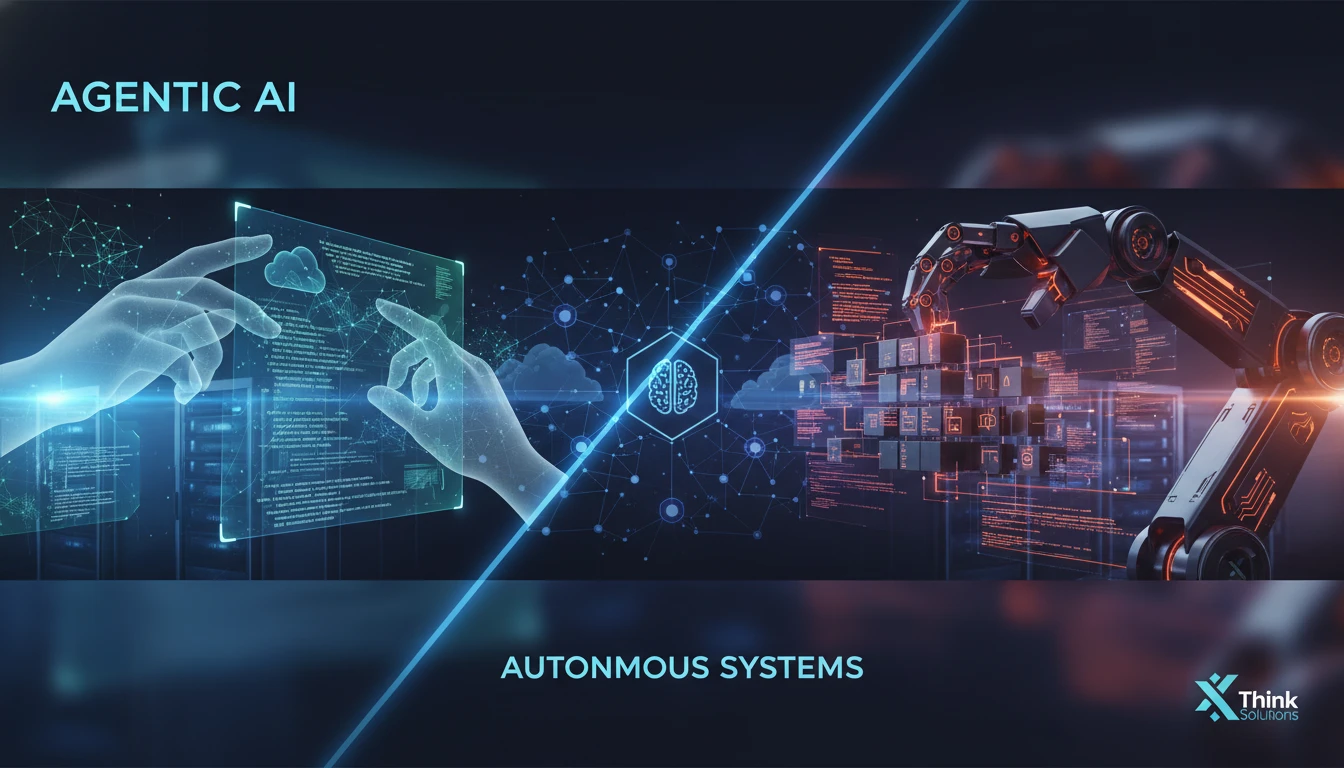
For the past two years, the technology sector has been fixated on Generative AI. We have marveled at the ability of Large Language Models (LLMs) to summarize documents, generate code snippets, and converse with human-like fluency. However, for CTOs and technical founders, the true paradigm shift is only just beginning. We are moving from the era of the Copilot—where AI assists a human operator—to the era of Agentic AI, where software operates autonomously to achieve broad, high-level goals.
Defining Agentic AI
To understand the magnitude of this shift, we must distinguish between standard LLM interactions and agentic workflows. A standard LLM is a reasoning engine trapped in a text box; it offers advice but cannot affect the world. Agentic AI combines that reasoning engine with access to tools (APIs, databases, web browsers) and a cognitive architecture that allows for planning, memory, and self-correction.
In an agentic system, the AI does not simply predict the next token. It perceives a task, decomposes it into steps, executes actions, observes the results of those actions, and iterates until the goal is met. It is the difference between asking a chatbot "How do I deploy this server?" and telling an agent "Deploy this application to AWS, configure the load balancer, and set up SSL."
The Architecture of Autonomy
For technical leaders, implementing Agentic AI requires rethinking software architecture. We are moving away from purely deterministic code paths toward probabilistic orchestration. A typical agentic architecture includes four pillars:
- Profiling & Memory: The ability to retain context over long periods, understanding user preferences and historical data, rather than resetting with every session.
- Planning: The capability to break complex directives into sequential sub-tasks (e.g., Chain of Thought or Tree of Thoughts prompting).
- Tool Use (Function Calling): The technical interfaces that allow the model to interact with existing enterprise software, from CRMs to CI/CD pipelines.
- Action & Reflection: A feedback loop where the agent evaluates the output of its tools and adjusts its plan accordingly.
The Shift to "Service-as-Software"
The economic implication of Agentic AI is the transition from Software-as-a-Service (SaaS) to Service-as-Software. Traditional SaaS sells a tool that makes a human more efficient. Agentic AI sells the outcome of the work itself.
Consider a Customer Support SaaS. In the traditional model, you pay for seats for your agents to use a ticketing system. In the Agentic model, you pay for the resolution of tickets. The software is the labor. For founders, this opens entirely new business models where value is pegged to outcomes rather than access.
Challenges for the Enterprise CTO
While the promise of autonomous software is immense, the path to production is fraught with challenges that require rigorous engineering standards:
1. Non-Determinism and Testing
Traditional software is deterministic; input A always leads to output B. Agentic systems are probabilistic. An agent might choose a different path to solve a problem on Tuesday than it did on Monday. CTOs must implement evaluation frameworks (Evals) that grade the quality of the agent's output rather than checking for binary exactness.
2. The Infinite Loop Problem
Agents planning their own steps can occasionally get stuck in logic loops, consuming tokens and API costs without resolving the task. Production systems require strict guardrails, "time-to-live" constraints, and human-in-the-loop intervention triggers.
3. Security and Permissions
Giving an AI write-access to your database or ability to send emails creates a significant attack surface. Prompt injection attacks—where malicious instructions override the agent's system prompt—become critical vulnerabilities. Implementing "Principle of Least Privilege" for AI agents is mandatory.
Preparing Your Organization
The shift to autonomous systems is not merely a feature update; it is an organizational restructuring. To prepare, technical leadership should focus on:
- API-First Infrastructure: Agents communicate via APIs. If your internal tools lack clean, well-documented APIs, your agents will be blind and deaf.
- Structuring Knowledge: Unstructured data is the enemy of automation. Investing in Vector Databases and clean knowledge graphs is the prerequisite for effective agentic retrieval.
- Human-Agent Collaboration: Design workflows where humans act as supervisors and reviewers, rather than operators. This creates a feedback loop that improves the agent over time.
Conclusion
Agentic AI represents the maturation of Generative AI from a novelty to a utility. By enabling software to perceive, plan, and act, we are unlocking a level of automation that was previously impossible. For Xthink Solutions and our partners, the goal is not just to integrate AI, but to architect systems where AI is the engine of execution.


Comments: